How We Bring AI to Your Business
AI should not start with a model, an agent or a platform. It should start with your business needs, your data, your existing processes and the outcomes you want to achieve.
At dinesQL, we help organizations move from AI ideas to practical, enterprise-ready solutions by first making sure the right data is available, then identifying what can be automated, and finally designing AI and agentic solutions that work across your people, systems and communication channels.
Talk to Us Our ServicesThe technologies and platforms may vary. The objective does not. We focus on your business requirement first, then decide the architecture, platform, models, tools and integration patterns that best fit it.
AI Starts with Your Data – Make Your Data Ready Before You Make It Intelligent
Most enterprise AI solutions depend on business data. Before introducing agents, workflows or AI models, we first look at the information your organization already has and whether it is ready to support reliable AI solutions. This includes understanding:
- What data is available
- Where the data is located
- How complete and accurate it is
- Whether different systems contain conflicting information
- How the data is structured
- Whether data is centralized or distributed
- How users currently access it
- What security and governance controls already exist
- Which data should and should not be available to AI
The objective is not necessarily to move everything into one database. The objective is to create a reliable, governed and accessible data foundation that AI solutions can use appropriately. Depending on your environment, this may involve:
- Data integration
- Data quality improvements
- Data cleansing
- Data modelling
- Centralized analytical platforms
- Lakehouse or warehouse architectures
- Semantic models
- Search and retrieval
- Business context
- Security and access control
We help prepare the data foundation before asking AI to reason over it.
From Data to Business Context – AI Needs More Than Tables and Documents
Having data available is only the first step. AI also needs to understand what that data means to your business. A customer, product, order, employee, supplier or service may exist across several systems and may be represented differently in each one.
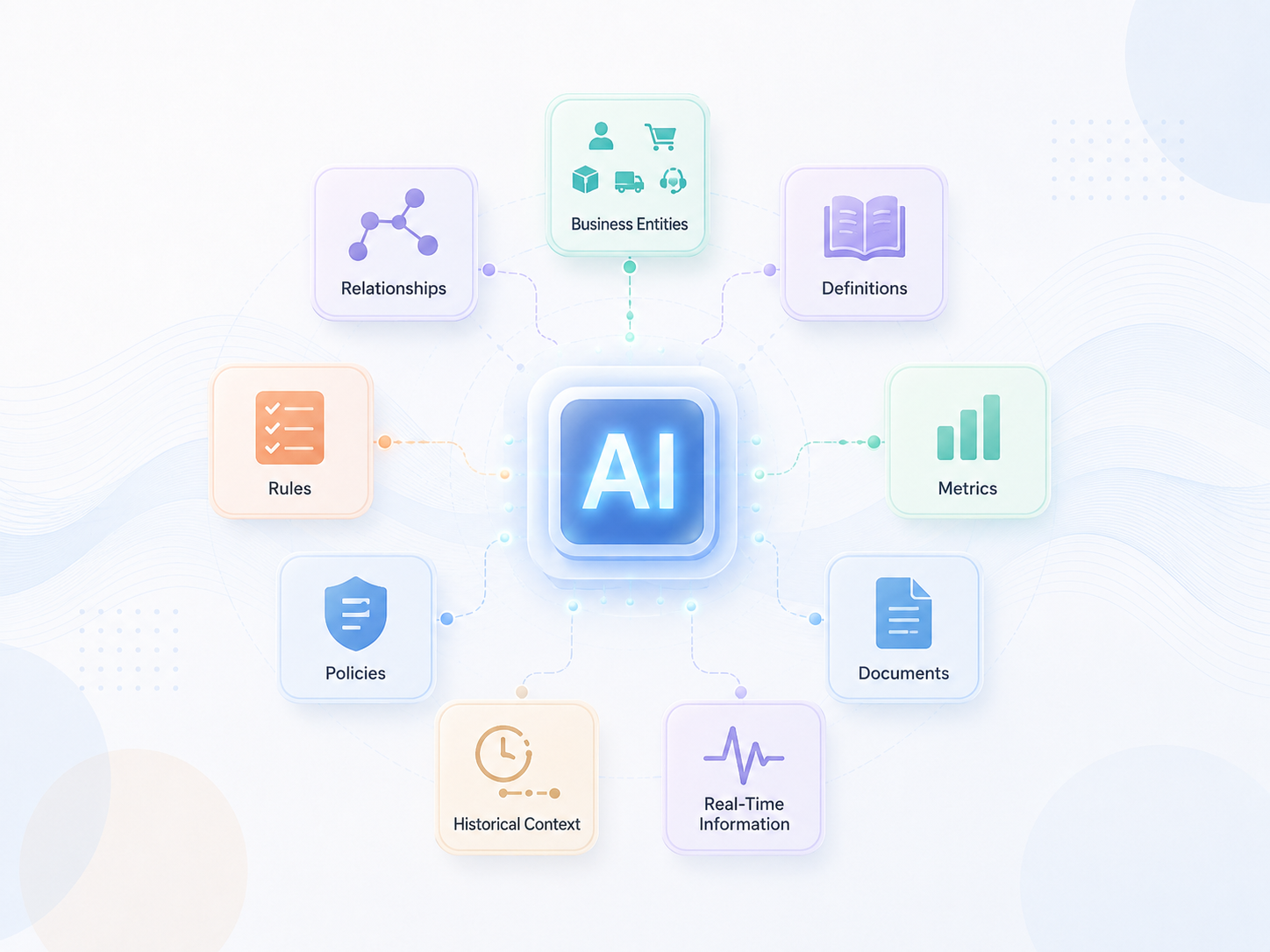
We help structure enterprise information so that AI solutions can work with business entities, relationships, definitions, rules, metrics, policies, documents, historical context and real-time information.
This allows AI to work with information in the way the organization understands it, rather than only seeing disconnected tables, files and APIs.
Understand What Can Be Automated – Do Not Use AI Where a Simple Workflow Is Better
Not every business process needs an AI agent. Some requirements can be solved more reliably using traditional automation, workflows, rules or application logic. We first study the process and determine what type of automation is appropriate. That may include:
- Rule-based automation
- Workflow automation
- Scheduled processes
- Event-driven processes
- API orchestration
- AI-assisted workflows
- Single agents
- Multi-agent solutions
The objective is to use the simplest approach that solves the business problem effectively. AI is introduced where reasoning, natural-language understanding, dynamic decision-making, unstructured information or flexible interactions provide a clear benefit.
Business Automation with AI – Combine Workflows, Rules and Intelligence
Many of the strongest enterprise AI solutions are not purely AI-driven. They combine deterministic business processes with AI capabilities. For example, a workflow may control the overall business process while an AI component:
- Understands a user request
- Extracts information from documents
- Classifies an enquiry
- Summarizes a conversation
- Determines the next action
- Selects an appropriate tool
- Generates a response
- Escalates when human intervention is required
This allows the solution to maintain business control while still benefiting from AI reasoning and flexibility.
Build Agentic Solutions – Move from Answering Questions to Taking Action
Traditional chatbots mainly respond to questions. Agentic solutions can go further. An agent can understand a request, determine what information it needs, use enterprise knowledge, call tools or APIs and complete an approved business action. We can design agents that:
- Answer questions using enterprise knowledge
- Query databases and analytical platforms
- Work with business applications
- Call internal and external APIs
- Execute approved actions
- Follow business rules
- Maintain conversation context
- Ask for missing information
- Hand work to another agent
- Escalate to a human when needed
The architecture may use one agent or multiple specialized agents depending on the complexity of the business requirement.
Single-Agent or Multi-Agent? Use the Right Pattern for the Problem
A multi-agent architecture is not automatically better. For simpler scenarios, one well-designed agent may be easier to manage, test and operate. For more complex solutions, specialized agents may be responsible for different areas and collaborate through orchestration patterns. Depending on the requirement, we may use patterns such as:
- Single agent with multiple tools
- Routing
- Agent handoff
- Sequential workflows
- Supervisor and worker
- Specialized agents
- Group collaboration
- Human-in-the-loop
We choose the pattern based on the business process, required control and operational complexity.
Connect AI to Your Enterprise Systems – Agents Become Useful When They Can Work with Your Business
An agent becomes much more valuable when it can securely work with the systems your organization already uses. We can connect AI solutions to:
- Databases
- Data warehouses
- Data lakes
- Microsoft Fabric
- Databricks
- APIs
- ERP systems
- CRM systems
- Internal applications
- Cloud services
- Document repositories
- Search platforms
- Custom business applications
This allows agents to work with current business information instead of relying only on static knowledge.
One Intelligence Layer, Multiple Stakeholders – Build AI for Employees, Customers, Partners and Operations
Enterprise AI is not limited to one group of users. The same underlying AI capability may need to serve different stakeholders in different ways. This can include:
- Internal employees
- Management
- Operational teams
- Customers
- Partners
- Suppliers
- External service providers
Each group may require different access, instructions, data and capabilities. We design the solution so that the AI experience reflects who the user is and what they are allowed to see or do.
Reach Users Through the Channels They Already Use – AI Should Come to the User
Users should not always have to open a new application just to interact with AI. Depending on the requirement, AI solutions can be made available through channels such as:
- Web applications
- Internal portals
- Mobile applications
- Microsoft Teams
- Other messaging platforms
- Voice interfaces
- Existing enterprise applications
- Custom applications
The same central AI capability can support multiple channels while keeping business logic, security and enterprise integration consistent.
Voice, Text and Multilingual Interaction – Let Users Interact Naturally
Not every user wants to type. Modern AI solutions can support:
- Text
- Voice
- Speech-to-text
- Text-to-speech
- Multiple languages
- Real-time conversations
This can be especially useful for customer-facing solutions, field users, operational teams and scenarios where mobile or hands-free interaction is important. The communication channel should fit the user, not force the user to fit the technology.
Human-in-the-Loop – AI Should Know When to Involve People
Automation does not mean removing people from every process. Some decisions require human approval, specialist knowledge or additional judgment. We can design solutions where AI:
- Handles routine requests
- Collects required information
- Prepares recommendations
- Suggests next actions
- Executes low-risk tasks
- Requests approval for important actions
- Escalates exceptions
- Transfers conversations to a human
The objective is to use AI where it adds value while keeping people involved where they are needed.
Platforms and Technologies – We Choose Technology Based on the Solution
We work with modern data, AI and cloud technologies, but we do not start a project by forcing a particular product or platform.
Depending on the requirement, the solution may use technologies such as:
- Microsoft Foundry
- Microsoft Fabric
- Databricks
- Azure AI services
- Large language models
- Vector search
- Semantic search
- APIs
- Cloud databases
- Data lakes and warehouses
- Workflow services
- Messaging platforms
- Voice services
- Custom applications
The final architecture depends on your:
- Business requirements
- Existing technology estate
- Data
- Security requirements
- Performance needs
- Internal skills
- Budget
- Operational model
Technology follows the requirement.
Models, Tools and Methods – Use the Right Level of Intelligence for Each Task
Different parts of an AI solution may require different models and techniques. A complex reasoning task may require a more capable model, while simpler extraction, classification or routing tasks may use smaller and more cost-effective models. We consider areas such as:
- Model selection
- Prompt and instruction design
- Structured outputs
- Retrieval-augmented generation
- Tool calling
- Semantic search
- Embeddings
- Agent orchestration
- Context management
- Memory
- Workflow integration
- Model routing
The objective is not to use the most powerful model everywhere. The objective is to use the right capability for each part of the solution.
Security and Governance from the Beginning – Enterprise AI Needs Control
AI solutions often interact with valuable and sensitive business information. Security cannot be added at the end. We consider:
- Authentication
- Authorization
- User identity
- Role-based access
- Data permissions
- Tool permissions
- Sensitive information
- Auditability
- Logging
- Business rules
- Approval requirements
- Content safety
- Data retention
An agent should only be able to access information and actions appropriate for the user and the business process.
Test Before You Trust – AI Solutions Need Continuous Evaluation
AI solutions behave differently from traditional applications. Testing cannot be limited to checking whether an API returned a successful response. We evaluate areas such as:
- Answer accuracy
- Groundedness
- Instruction following
- Tool selection
- Business-rule compliance
- Response consistency
- Safety
- Escalation behaviour
- Expected output formats
Representative business scenarios should be tested before production and continuously reviewed as the solution evolves.
Trace, Monitor and Improve – Understand What the AI Is Doing
When an AI solution produces an unexpected result, you need to understand why. We design observability around areas such as:
- Model calls
- Instructions
- Retrieved knowledge
- Tool selection
- Tool inputs and outputs
- Agent handoffs
- Latency
- Errors
- Token usage
- Cost
- User interactions
This makes it possible to diagnose issues and continuously improve the solution.
Take AI into Production – Move Beyond the Proof of Concept
Building an impressive demonstration is relatively easy. Building an enterprise solution that operates reliably every day is harder. Moving into production requires consideration of:
- Architecture
- Reliability
- Scaling
- Security
- Error handling
- Monitoring
- Deployment
- Cost control
- Support
- Change management
- Governance
We help organizations move from experimentation to production-ready AI.
How We Work with You – Business Need First. Technology Second.
Our approach can be summarized as: Understand → Prepare → Automate → Build → Integrate → Govern → Scale
-
Understand
Understand the business requirement, users, existing processes and desired outcome.
-
Prepare
Assess and prepare the data, knowledge and enterprise systems needed by the solution.
-
Automate
Identify what can be handled using workflows, rules and traditional automation before introducing unnecessary AI complexity.
-
Build
Design the appropriate AI or agentic solution using the right models, tools and orchestration patterns.
-
Integrate
Connect the solution to enterprise data, APIs, applications and communication channels.
-
Govern
Implement security, permissions, evaluations, tracing and operational controls.
-
Scale
Take the solution into production, monitor it and extend it as new business requirements emerge.
The Platform Is Not the Starting Point – Your Business Requirement Is
We work with modern platforms and technologies, but we do not recommend a technology simply because it is new or popular. A solution may use Microsoft Foundry, Fabric, Databricks, custom applications, workflow services, messaging platforms or a combination of technologies.
The architecture is selected after understanding:
- What you need to achieve
- What data you have
- What systems you already use
- Who will use the solution
- How they will interact with it
- What the solution is allowed to do
- How it will be governed and operated
Our objective is not to sell a platform. Our objective is to help you implement the right AI solution for your business.
Ready to Bring AI into Your Business?
You do not need to start with a large AI transformation program. Start with the business problem. We can help you understand your current data and systems, identify where automation and AI can provide value, design the right architecture and take the solution from idea to production. Talk with our AI Agent to explain what you are trying to achieve and learn how we can help.
Talk with Our AI Agent Make an Appointment